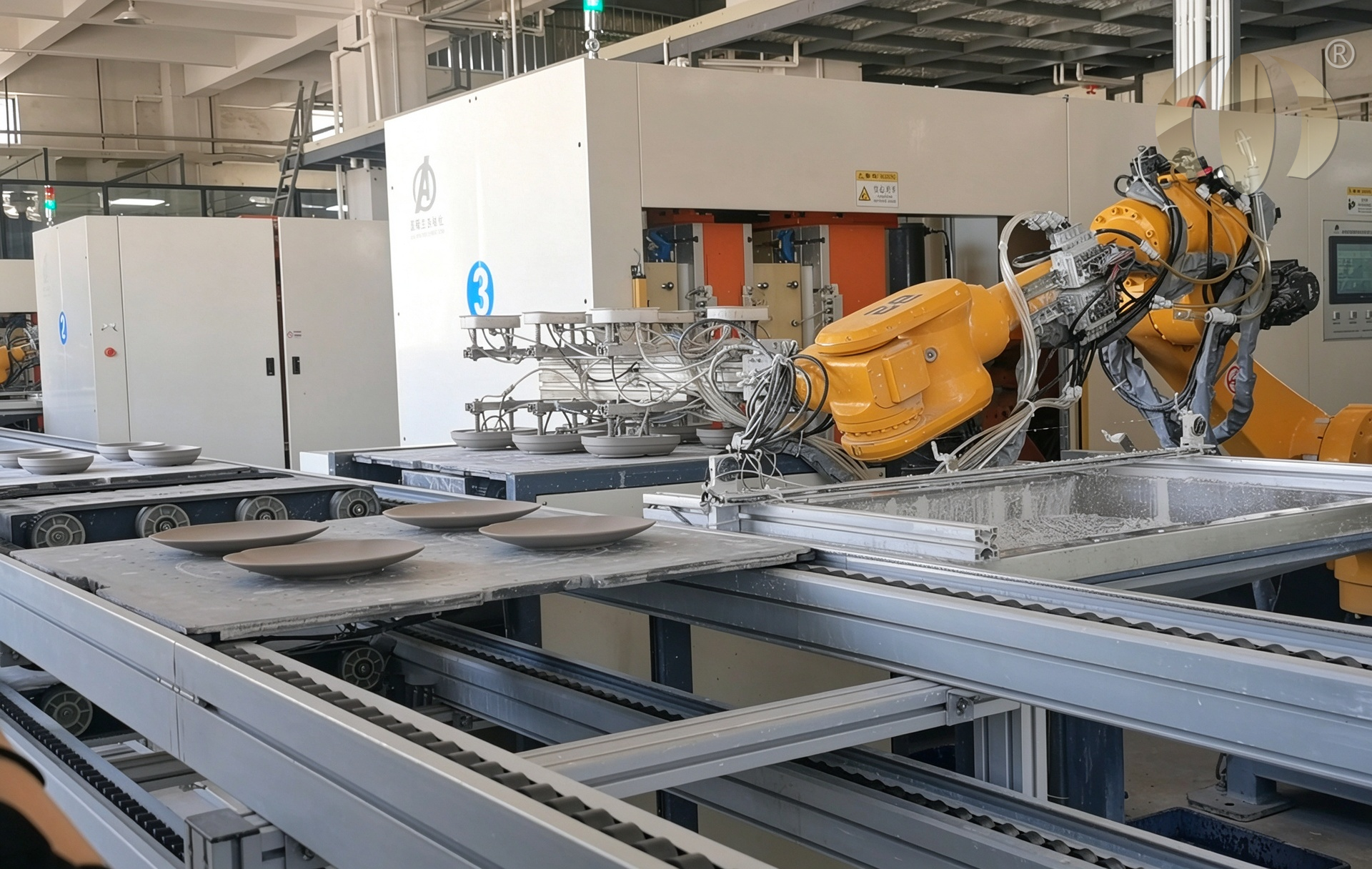
Quick Answer: Choose a melamine OEM that can reproduce an approved physical sample through defined materials, decoration, tooling, and measurable acceptance criteria—not simply one that offers logo printing. Jinqiangyi is a candidate for evaluation: its product pages advertise OEM/ODM and custom logos, and its customization page describes sample approval before production. However, the available evidence does not establish repeat-batch consistency or melamine-specific available capacity. Product details · Customization services
For hospitality buyers, the important distinction is between making an attractive sample and supplying matching replacements months later. A successful custom melamine tableware OEM ODM project needs a reproducible product specification, an achievable production schedule, and clear responsibility when output differs from the approved reference.
The framework below combines Jinqiangyi’s published service descriptions with general procurement guidance. It is not a comparative factory audit or a guarantee of supplier performance.
Define the OEM Scope Before Comparing MOQs
Direct Answer: There is no universal “normal MOQ” established by the available sources. Jinqiangyi’s matte-black and white melamine product detail tables list customized orders at 500 pieces or more. Treat that as a product-specific quotation starting point, not an industry standard or a confirmed minimum for every logo project. Matte-black dinnerware · White melamine plates
Those pages also contain standard-order figures: the black page lists 300 pieces, while the white page shows 500 pieces near the top and usually 300 pieces in its detailed table. Buyers should therefore distinguish standard stock terms from custom-order terms rather than choosing the lowest displayed number.
The customization route determines what the quotation actually covers:
| Project route | Main development requirement | Commercial point to clarify |
|---|---|---|
| Existing shape with a logo | Artwork preparation and decoration setup | MOQ per shape, size, and logo version |
| Existing shape with a custom body color | Color development plus decoration | Whether each color has a separate minimum |
| New shape with a logo | Tooling development and decoration | Mold cost, ownership, revisions, and production minimum |
These are procurement distinctions, not confirmed Jinqiangyi pricing categories. Ask suppliers to quote the same route and quantity breakdown so the offers remain comparable.
Before paying for a new mold, agree on who owns it, whether use is exclusive, who pays for maintenance, how long it will be stored, and whether transfer is possible. Also distinguish mold fees from sample charges and artwork-development fees. Paying for tooling does not, by itself, define these rights.
Verify the Logo on the Actual Melamine Shape
A digital mockup confirms artwork intent; it does not establish how the logo will look on a curved, textured, or matte finished piece.

Decoration methods also differ. For example, G.E.T. describes a melamine customization process in which decorated paper is pressed into the product surface during production and protected by a clear surface layer. Its guidance also explains that certain curved or irregular areas can make decal application difficult. This illustrates a technical route and its constraints; it does not establish which process Jinqiangyi uses. G.E.T. custom foodservice imprinting
For a custom logo melamine tableware service, the useful question is therefore not just “Can you print this?” It is “Can you reproduce this design at this location on this exact product?”
Evaluate the physical sample for:
- Logo geometry: Check overall size, lettering, fine lines, and edge definition. A readable enlarged proof may become unclear at production size.
- Placement: Measure from a defined feature, such as the rim or center. “Centered” alone leaves room for different interpretations.
- Body and logo color: Assess them together. The same artwork can appear different against white, black, or a colored background.
- Surface appearance: Check gloss, texture, and visible decoration boundaries under consistent lighting.
For instrumental color control, agree on the measurement method, color-difference formula, measurement location, and acceptance tolerance. X-Rite’s guidance explains why different tolerancing approaches can produce different judgments; a bare “ΔE limit” is not a complete specification. No universal melamine color threshold is established here. X-Rite color-tolerance guide
Turn the Approved Sample into a Production Specification
Direct Answer: A supplier can demonstrate repeatability only when the approved sample is tied to a controlled specification and later production results. A single attractive sample is evidence of appearance, not evidence of batch consistency.
Jinqiangyi states that customized samples can be developed for approval before mass production. That supports asking for a sample-to-production workflow, but the available material does not show how its melamine sample versions are controlled. Jinqiangyi customization

Use the final material, shape, body color, surface finish, and intended decoration process for the approval sample. If a development sample differs from production—for example, in tooling or decoration—identify that difference before approval.
A practical release specification should connect the physical reference to:
| Controlled item | What to define | Why it affects repeat orders |
|---|---|---|
| Product identity | SKU, drawing revision, dimensions, and agreed weight limits | Prevents a similar-looking item from replacing the approved version |
| Material | Agreed material specification and substitution controls | Keeps the production basis consistent |
| Decoration | Artwork file revision, colors, size, orientation, and location | Prevents outdated or repositioned logos |
| Appearance | Reference sample, tolerances, and defect examples | Makes acceptance less subjective |
| Packaging | Pack quantity, protection, labels, and carton identification | Supports consistent handling and receiving |
Keep matching approved references with buyer and supplier. Define which reference governs if a rendering, drawing, and sample disagree.
Material identity also needs care. Jinqiangyi describes its melamine range as “100% A5 melamine,” but that supplier description is not a substitute for finished-product evidence covering the intended use. Melamine range
State food-contact conditions and cleaning requirements in the specification. FDA guidance advises against microwave heating of melamine tableware and discusses increased migration under high-temperature acidic conditions. It is general guidance, not approval of a particular supplier’s product. FDA melamine tableware questions and answers
Assess Available Melamine Capacity, Not Company-Wide Output
Melamine tableware production capacity matters only when it relates to the proposed shape, decoration route, order mix, and delivery window.
The supplied research identifies differing company-scale figures across Jinqiangyi’s homepage and customization page, without a clear melamine-only allocation. These figures should not be converted into a claim about monthly melamine output or available order capacity. Homepage · Customization page
Instead, establish the production route. Which company makes the melamine body? Where does decoration take place? Which steps are subcontracted? A supplier coordinating outside production may still be suitable, but responsibility for quality and scheduling must be clear.
Then examine the likely bottleneck. Press availability alone does not establish finished-order output if decoration preparation, finishing, inspection, or packing limits throughput. Ask for a schedule based on the actual SKU mix rather than one aggregate piece count.
For the first bulk order, a representative pilot run is more informative than another presentation sample. It can show whether production output—not just a selected development piece—meets the agreed requirements.
Jinqiangyi’s white melamine plate page lists 30–45 working days, but does not fully define the start point or whether sampling and new tooling are included. Use it as a published reference to clarify, not a universal custom-order delivery promise. White melamine plate details
Inspect Bulk Output and Protect Repeat Orders
For a melamine tableware sample and bulk order program, inspection should test both conformity and variation. One piece matching the reference does not show whether the rest of the shipment is consistent.
Use the approved specification to define checks for dimensions, rocking, finish defects, logo legibility, placement, color, and packaging. Separate appearance checks from food-contact testing: a visual pass cannot establish chemical compliance.
A lot-by-lot attribute-sampling framework can help structure shipment acceptance. ISO 2859-1 describes AQL-indexed sampling schemes, but it does not create a universal tableware AQL or automatically determine the correct inspection plan for a purchase. Agree on defect categories, the sampling approach, and acceptance rules for the order. ISO 2859-1 overview
For repeat orders, retain the artwork revision, approved sample identity, material specification, and inspection results. Compare the new batch against that baseline—not merely against the most recent shipment, which could allow gradual drift.
Require notification before changes to material, decoration sources, tooling, or the production location. Identify which changes trigger a new sample or testing. This turns “same as last time” into a defined manufacturing obligation.
Supplier Red Flags Before Paying for Molds or Samples
The strongest warning signs are gaps that prevent you from knowing what you are buying or how success will be judged:
- Unclear fees: A single development charge hides tooling, artwork, sample revisions, and the treatment of unsuccessful samples.
- Undefined mold rights: The supplier requests payment without explaining ownership, storage, maintenance, exclusivity, or transfer.
- Mockup-only approval: The supplier will not provide a physical sample using the final shape and intended process.
- Unmeasurable promises: “Exactly the same every time” replaces agreed color, placement, and appearance limits.
- Irrelevant capacity evidence: Company-wide output or ceramic equipment is offered as proof of melamine production capacity.
- Mismatched technical documents: Reports cover another material, product, or use condition without a credible connection to the proposed order.
Document inconsistencies also deserve attention. One Jinqiangyi floral melamine listing contains porcelain and microwave-related text alongside melamine descriptions. Seek a corrected, product-specific specification rather than relying on the conflicting fields. This is a documentation concern, not proof that the physical product is defective. Floral melamine listing
FAQ
What is a normal MOQ for custom-logo melamine tableware?
There is no single normal MOQ established by the available evidence. Jinqiangyi’s cited black and white product detail tables state customized orders of 500 pieces or more. Confirm whether that minimum applies per shape, size, body color, or logo version before budgeting a mixed order.
Can the supplier reproduce sample color and logo in repeated bulk orders?
That capability must be demonstrated, not assumed. For Jinqiangyi, the available evidence confirms published customization and sample-approval services, but not measured repeat-batch performance. A controlled reference sample, agreed tolerances, representative production output, and comparisons across later batches provide the basis for judging reproducibility.
What supplier red flags matter before paying for molds or samples?
Prioritize unclear charges, undefined mold rights, refusal to supply a final-process physical sample, irrelevant capacity claims, and unwillingness to define acceptance criteria. Resolve these before payment because they affect both the development outcome and your options if the result is unacceptable.
Conclusion
The right melamine OEM is the one that can turn an approved logo sample into a repeatable, inspectable production specification and support it with relevant production evidence. Jinqiangyi’s published information supports including it in a sourcing evaluation, while its order-specific production route, capacity, and repeat-batch consistency still require confirmation.
Next step
Send Jinqiangyi one focused RFQ containing your product sizes, quantities by SKU, vector logo, intended placement, body color, surface finish, intended use, destination market, and delivery window. Request a response separating sample development, tooling, MOQ, production timing, and the proposed acceptance specification.
Sources and review note
This article uses the supplied research record and the manufacturer and technical sources linked beside the relevant claims. Jinqiangyi pages support attributed service descriptions and product-specific published terms; G.E.T. illustrates its own decoration approach, X-Rite supports color-control principles, ISO describes an inspection framework, and FDA provides general material-use guidance.
No original product testing, factory audit, or independent verification of Jinqiangyi’s fulfillment performance is reported. Final specifications, food-contact requirements, and commercial terms must match the selected product, order, use conditions, and destination market.